Sunday, September 16, 2012

Some iPhone 5 pre-orders to ship faster than expected

The iPhone 5 pre-order kickoff yesterday morning was fairly reminiscent of last year’s launch. Apple’s website, despite having months to prepare, quickly buckled under the influx of traffic, and more than half an hour passed before some folks could logon.
The real story though is how fast the initial pre-order stock of iPhone 5s ran out. Shipping times slipped from one to two weeks in less than an hour. Some people even saw their ship dates drop a week during the time it took them to place their order

Samsung’s new Galaxy S III ad takes on the iPhone 5

“It doesn’t take a genius,” according to Samsung’s new ad, to see that the Samsung Galaxy S III is a better handset than Apple’s new iPhone 5. “The next big thing is already here,” it says.
The ad, which Samsung will start running in national and regional newspapers tomorrow, does a side-by-side comparison of the two phones, with the Galaxy S III appearing superior

Saturday, September 15, 2012

VonCase cages your iPhone in aircraft grade aluminum

At vonCase Designs, the team aspires to create an “exceptional iPhone case that is as unique as it is durable.” Utilizing American-made aircraft grade aluminum to craft complex designs with a hand-finished touch, vonCase enters with four eccentric iPhone cases that catch attention. Anodized for a permanent finish, the Variants, pop with vivid color and protect your precious device from drops and dings

Apple posts full iPhone 5 schematics

This is pretty interesting. It looks like Apple has posted up the full schematics for the iPhone 5 on its developer website. Even if you’re not a dev, you can find them in the Resources section.
Essentially, these are the blueprints for Apple’s new smartphone. And they give accessory and case makers dimensions for everything from the ringer switch to the home button

Sunday, September 9, 2012

Delta and American Airlines also working on Passbook support

After months of waiting, we should finally get to see Passbook in action this month. Apple unveiled the app, which stores digital gift cards, event tickets and boarding passes, during its WWDC event.
As cool as the idea of Passbook is, it will only be successful if it can garner support from major businesses. But if the enthusiasm of the airlines is any indication, that won’t be a problem…
Hot on the heels of the story that Virgin Australia is already testing Passbook, comes a report that claims that both Delta and American Airlines are also actively working to support the service.
Travel site Skift has the scoop:
“A spokesperson for American Airlines reveals it will be “rolling out an app update in the coming weeks in support of Passbook. In the meantime, customers can still access their mobile boarding passes in the current version of American’s mobile app.”
And, Delta is known to be actively working on supporting Passbook’s functionality for mobile boarding passes, although the airline wouldn’t talk about it publicly.”
The author says that a spokesperson for United Airlines declined to comment on the matter, but points out that a United boarding pass is present in Apple’s screenshots of the Passbook app.
Again, if this is a sign of how other businesses are going to approach Passbook support, the sky is the limit. Imagine never having to carry another physical boarding pass, movie ticket or gift card.
What’s your take on Passbook? Will it be a hit, or will it fall on its face?

Apple researching new haptic feedback technology

Just hours before Apple unveiled its third-generation iPad this year, a report came out suggesting that the tablet could feature some sort of new haptic “touch-feedback” display.
Obviously, the story never materialized. But as it turns out, Apple is looking into it. The company has had over 4 patents published this year on haptics, including this one…
PatentlyApple points to a newly published invention from Apple regarding a “linear vibrator providing localized haptic feedback.” Here’s an excerpt from the description:
“Further, the vibrator may be configured to be activated when a user touches a particular portion of a touch-sensitive screen of the mobile phone. When the user’s touch or near-touch is sensed in the appropriate area of the screen, the vibrator may be activated in a boosted mode, thereby providing localized haptic feedback directly under the area in which the touch was sensed. In this manner, the localized haptic feedback may serve to confirm the touch to the user, for example by emulating the feeling of pressing a button.”
This particular patent application, #20120223824, was originally filed in the first quarter of this year, with Fletcher Rothkopf named as the inventor, and was published Thursday.
There’s obviously a million ways Apple could implement this kind of technology into its mobile devices. But the question is: should it? Is there a need for haptic in touch screens?
I think if it’s done right, it could make a positive impact — especially in gameplay.
What do you think?

Monday, September 3, 2012

Super Smash Bros. arrives on jailbroken iPhones, but it’s obviously not the real deal

Super Smash Bros. has arrived on iOS in the form of Super Smash Bros. Mobile, but outside of the name, and a few somewhat recognizable characters and levels, it plays almost nothing like the entries in the popular Nintendo franchise.
That probably has a little something to do with the fact that “Super Smash Bros. Mobile” is a completely unauthorized — and certainly trademark infringing — game created with a tool called Game Editor. The game is available for free on Cydia’s BigBoss repo, so it’s not like Apple has any control over removing it from public availability.
Game Editor is a tool that, according to its official website, allows users to “Create 2D games with little or no programming knowledge” — a fact becomes instantly apparent once you fire up Super Smash Bros. Mobile for the first time.
Needless to say, despite the best efforts of the developer, Super Smash Bros. Mobile is a pretty poor representation of the real thing. Not only is it extremely difficult to control with the on screen buttons, the animations run at a really low frame rate, there’s no sound during game play, and the character selection list is lacking heavily.


Bruce Willis goes after Apple over iTunes music ownership

Die Hard trilogy star Bruce Willis is reportedly considering legal actions against Apple over iTunes policy which governs the ownership of digital music files. The actor has amassed a music collection worth thousands of dollars that is being accessed via “many, many iPods”.
The action hero is keen on handing his vast digital music collection legitimately to his daughters Rumer, Scout and Tallaluh upon his death. Conversely, Willis has eventually discovered that under Apple’s pesky rules one does not actually own the tracks and instead borrows them under a non-transferable license.
Deciding enough is enough, the 57-year-old actor is reportedly prepping to unleash legal sharks on Apple in order to break Cupertino’s restrictive digital content policy, which could have major repercussions given Apple’s choke-hold of the music market…
Neil Sears, writing for The Daily Mail, reports:
 The Hollywood action hero is said to be considering legal action against technology giant Apple over his desire to leave his digital music collection to his daughters.
If he succeeds, he could benefit not just himself and his family but the millions who have purchased songs from Apple’s iTunes Store.
Willis is reportedly supporting proposed legislation in five U.S. states that aims to give downloaders more rights to their digital content.
He’s also considering another interesting option which calls for his lawyers establishing family trusts as the “holders” of his downloaded music.
Actually, this same issue also piqued my interest three years ago, when I argued in a piece over at Bright Side of News* that Apple should allow folks to sell the apps they had bought for their iPhone.
I wrote:
When you think of it, this should be imposed by the letter of the law. You can legally sell purchased boxed software to anyone so why wouldn’t the same customer freedom apply to downloadable software for mobile devices?
I also wonder why it is taking so long for consumer advocates to bring this issue before the general public and pressure Apple into providing a satisfactory solution.
Over at Geek.com, I also opined that people should be entitled to read electronic books on whatever device they choose, regardless of their platform or device preference.
Now, Apple’s iTunes Store terms of service don’t specifically mention the transfer of ownership rights to purchased songs to another person.
As for mobile and desktop apps sold via the App Store and the Mac App Store, Apple’s policy is clear: your rights to purchased apps are limited to a nontransferable license to use them only on iOS devices and Macs that you own or control.
Music ownership was managed in a stricter manner back in the days when Apple had been enclosing music files in its FairPlay digital rights management solution to prevent unauthorized use.
Then Apple dropped DRM in favor of unprotected MP3s, making it easy to create copies of songs for personal use and play tracks on non-Apple devices. It’s the lack of DRM which also complicates any possible solution that might enable one to legally weave rights to their songs and transfer ownership to any one person.
Why?
Because those unprotected MP3s can now be easily be copied and used on multiple devices (though Apple still embeds a buyer’s Apple ID in song meta data).
At the end of the day, it’s a legal rather than technical matter.
All Apple needs to do is talk to labels, gain approvals for broader music rights and update iTunes terms of service.
Do you think Apple should broaden our rights to use digital content purchased via its many stores?


Thursday, August 23, 2012

Don’t jump the gun in Keri Racing

Keri Racing, from Neowiz Internet (the same company that brought us London 2012, the official iOS game of the Olympics), takes on the hottest social network game hits by combining multiple genres in one fun new universe. Whether you’re a solo player or prefer to help friends and compete with them, Keri Racing has you covered.
Named for the cute cartoon birds that serve as mounts for racing against both the AI and friends in real-time, Keri Racing combines farming, being a business mogul, pet raising, RPG-esque stats building, and action-packed interactive racing to provide a unique social and racing experience. But the main goal here is to dominate the racing circuit by raising and racing your pet keris…
The menu-based controls for the sim-oriented portions of the game are fast and easy to navigate. Farming, business building, and pet raising are smoothly integrated in an elegant, creative interface. The game’s action portion, racing the adorable keris, offers easy to learn controls and plenty of different environments, tracks, and modes of play to keep gamers coming back for more.


LG begins mass-producing thinner displays ahead of new iPhone launch

We’ve heard several reports over the past few months that Apple is using a new, thinner display in its next iPhone. The tech is called in-cell, and will help slim down the handset.
Interestingly enough, LG Display’s CEO Han Sang-beom announced today that his company has just started mass-producing a new line of thinner, smartphone display panels…
Reuters reports on the CEO’s comments this evening, and it’s clear it believes that LG’s new display panels are going to be used in Apple’s next-generation iPhone.
“Sources have told Reuters that the panels for the new iPhone will be 4 inches corner to corner — 30 percent bigger than current iPhones.
The iPhone screens will also be thinner than previous versions with the use of so-called in-cell panels. The new technology embeds touch sensors into the liquid crystal display, eliminating the touch-screen layer found in current iPhones.”
It’s worth noting that LG is a panel supplier for Apple, and the company was tapped as a next-gen iPhone display-maker by The Wall Street Journal back in May. So it’s possible that Reuters is spot-on, further confirming reports that the next iPhone will have a thinner, larger screen.
As far as the specs of the displays, they’re said to have a resolution of 1136 x 640 and a PPI (pixels per inch) of 326. Essentially they’ll have the same width and PPI as the iPhone 4S.
Apple is expected to unveil the new iPhone at a media event on September 12. Pre-orders are said to start the same day, with the handset arriving in retail stores the following week.


Tuesday, August 21, 2012

AT&T’s FaceTime limits could violate F.C.C. rules

AT&T sent shockwaves through the tech community last week when it announced its future plans for iOS 6′s new FaceTime over Cellular feature. The good news is that it won’t be charging separately for the service, but the bad news is only customers on its new Mobile Share data plans will be able to use it.
As you can imagine, this has folks upset — particularly AT&T customers who are still on unlimited, or other legacy, data plans. Why should they have to switch to a [likely] more expensive data plan to use the feature? Well, according to Public Knowledge’s senior lawyer John Bergmayer, they shouldn’t have to…
The New York Times reports:
“Public Knowledge, a nonprofit group that focuses on Internet law, says that by prohibiting its other customers from using the video-calling feature on the network, AT&T is violating net-neutrality rules by blocking a service that potentially competes with its own.
John Bergmayer, senior staff lawyer at Public Knowledge, said AT&T was violating the F.C.C.’s Open Internet Rules, which say that mobile providers shall not “block applications that compete with the provider’s voice or video telephony services.”
AT&T, of course, is maintaining that it has done nothing wrong. Here’s a statement from Mark Siegel, a spokesman for the carrier:
“FaceTime is available to all of our customers today over Wi-Fi, and now we’re expanding its availability even further as an added benefit of our new Mobile Share data plans.”
The F.C.C. (Federal Communications Commission) has thus far not commented on the situation, but don’t count it out. The agency has been known to get involved with carrier affairs — most recently, telling Verizon it could no longer block third-party tethering applications and fining it $1.25 million.
It’ll be interesting to see how this unfolds, both from a legal and customer turnover standpoint. Apple is launching a new smartphone next month, and AT&T is already expected to lose a number of customers in favor of Verizon’s much larger LTE network. And this can’t possibly be helping its cause.
What do you think, should the F.C.C. get involved here?


Final settlement talks fail between Apple and Samsung CEOs

With the witness testimony stage over with, and the trial set to be handed over to the jury this week, Judge Lucy Koh pleaded with CEOs from both companies to meet one last time today to try and resolve their differences.
Well according to Samsung attorney Kevin Johnson, the two CEOs did speak today. But, as you might have guessed, the last-minute settlement talks failed. It looks like the high-stakes trial is going to be left up to the jury…
The Verge reports:
“We’d heard rumors that the CEOs of Apple and Samsung were getting together today for one last court-mandated meeting, but their discussion proved unfruitful. Samsung attorney Kevin Johnson just told Judge Lucy Koh that “The CEOs did speak…There was no resolution.”
The meeting was a last ditch effort to bring the legal battle between the two companies to a halt before closing arguments start tomorrow. Because after that, the verdict and fate of these two tech giants will be put in the juries hands.
Judge Koh has stated on several occasions that the stakes were too high in this trial to leave it up to a group of citizens. And that’s why she has continued to urge both companies to try and resolve their differences outside of court.
That being said, the schedule for the remainder of the trial is as follows: closing arguments are set for tomorrow, and jury deliberations are expected to begin Wednesday. And then, it shouldn’t be too long before we hear a verdict.
How would you vote? Is Samsung guilty or not guilty of copying Apple?


Sunday, August 19, 2012

Photos of complete next-gen iPhone front panel surface

The amount of claimed leaked next-generation iPhone parts we’re seeing is starting to get out of control. Yesterday we saw a purported dock connector for the handset, and now this.
The above photo is of what’s believed to be a complete front panel belonging to Apple’s next smartphone. It has the rumored elongated display, and a repositioned FaceTime camera…
MacRumors has the pics, which were uploaded by nationwide repair shop UBreakiFix. The firm says that it received the photos from one of their distributers and they appear legitimate.
The display in the next iPhone is said to measure 4-inches in diagonal, up from 3.5-inches, with a resolution of 1136 x 640. This theory has been corroborated by a number of news outlets, as well as a recent discovery that Apple’s upcoming software scales to fit such a display.
At this point, it’s hard to imagine that the designs seen in previous part leaks are anything but accurate. They’re Apple-like, they’re consistent, and there’s obviously a lot of them floating around.
Of course, Apple could still pull a 180 and surprise everyone at its iPhone event next month. But we’re not counting on it.


Apple kinda responds to the SMS security flaw found in iOS

Yesterday we broke the news that our friend and iOS hacker pod2g had uncovered a major security flaw in the way the iPhone handles SMS. The exploit basically allows anyone to specify a different “reply-to” phone number when sending you a text message. You can easily imagine various scenarios of how this could be used maliciously.
Today, Apple sent a statement that doesn’t necessarily makes us feel better about the exploit found, but which does insist on the fact that iMessage is more secure than standard text messages…
In a statement sent to Engadget, Apple explains:
Apple takes security very seriously. When using iMessage instead of SMS, addresses are verified which protects against these kinds of spoofing attacks. One of the limitations of SMS is that it allows messages to be sent with spoofed addresses to any phone, so we urge customers to be extremely careful if they’re directed to an unknown website or address over SMS.
Apple is basically telling us two things here:
iMessage is safer than SMS
They are not going to do anything about this SMS exploit
Move along, sir. If you expected Apple to take care of this safety concern for you, you’re going to have to rethink your expectations. To be fair though – and noting that I am no SMS expert – it is my understanding that SMS is an international standard that is mostly a carrier responsibility, and I don’t think Apple can do anything about this issue. But again, I’m no SMS/security expert and I might be wrong.
Lesson learned. Do not trust any suspicious text message! But didn’t we already know that?


Saturday, August 18, 2012

Final day of testimonies complete in Apple vs Samsung trial

The end of the Apple-Samsung trial is drawing near, as the final day of witness testimonies is now complete. Both sides have exhausted their allotted 25 hours of arguments, and the case will soon be turned over to the jury.
In honor of this occasion, we thought we’d take a look back at some of the week’s more interesting moments in the case, from Samsung’s denial of copying Apple’s icons, to Judge Koh’s “smoking crack” comment…
Sick of the arguing – one of the more interesting aspects of this trial has been US District Court Judge Lucy Koh. She’s had no problems telling the attorneys from both sides what’s on her mind, and this week started off with her ordering them to stop arguing and agree on final jury instructions.
We didn’t copy Apple’s icons – last week, Apple’s attorneys show the jury some half a dozen images of Samsung’s icons and how they were similar to those found in iOS. This week, Samsung called on the designer of its Galaxy icons Jeeyuen Wang to testify. Obviously she testified that she didn’t copy.
Apple lifted the iPad’s design – one of Apple’s many claims against Samsung is that it intentionally copied the design of its iPad. Whether it did or didn’t, Samsung’s best line of defense against this in court is to present prior art. And it did, or at least tried to, with this tablet from 1981.
Galaxy Tab 10.1 came first – Samsung brought its industrial designer, Jin Soo Kim, to talk about the timeline of the company’s work on its Galaxy Tab 10.1 tablet. The word is, Samsung watched Apple unveil its iPad 2, and sent its designers “back to the drawing board.” This one’s interesting.
Are you smoking crack? – this hilarious line from Judge Koh probably made 1000 headlines yesterday. The comment came after Apple’s attorneys submitted a 75-page briefing of witness instructions. Koh, being the outspoken person she is, told Apple’s litigation team to pare it down.
The testimony phase ended on a dull note today. Most of the day’s witnesses were return witnesses, and Samsung’s side was pretty quiet, as it only had 46 minutes of court time left compared to Apple’s four hours.
There will likely be some last-minute filings over the weekend, and lawyers will meet with the Judge on Monday for final instructions. The trial resumes Tuesday with closing arguments, and then it’ll be handed over to the jury.
And the verdict they deliver will be one of the biggest in corporate history. If Apple wins, Samsung could owe as much as $2.5 billion dollars in damages. And if Apple loses, that opens up its designs and patents to a lot more copying.
Stay tuned.


Motorola files its second ITC suit against Apple

Google-owned handset maker Motorola Mobility on Friday filed its second lawsuit against Apple with the U.S. International Trade Commission (ITC) that could see Apple’s Mac computers, iPhones and iPads banned from sale in the United States…
Bloomberg relays an e-mail statement by the Illinois-based Droid maker:
We would like to settle these patent matters, but Apple’s unwillingness to work out a license leaves us little choice but to defend ourselves and our engineers’ innovations.
The Wall Street Journal chimed in, writing that Motorola accused Apple in the filing of breaching seven of its patents related to location-based reminders, Siri, push email notifications and media playback on cell phones, amongst others.
Motorola today also issued press invitations for an product launch slated for August 5 (Droid Razr HD, perhaps?), conveniently a week before Apple is rumored to unveil the next iPhone and the same day Microsoft/Nokia have their own Windows Phone 8/Lumia related presser.
It’s gonna be a crowded September.
Motorola and Apple locked horns over patents in 2010, following failed licensing talks. Apple argues that the Droid maker is refusing to license standards-essential patents on fair terms while claiming that Motorola’s Android-driven devices ripped off key patented features of the iPhone.
The ITC is also reviewing a previous ruling from Motorola’s first ITC case against Apple. That ruling, due August 24, could have devastating consequences for California-based Apple because asserted patents cover crucial 3G technology used in both iPhones and iPads.
Apple on its part argued that the tech is standards-essential and should be licensed at a fair and reasonable price under the FRAND act.
Remember, Motorola previously won a case against Apple in Germany over its data synchronization patent. As a result, iCloud users cannot have iCloud email pushed to their iOS devices while located within the borders of Germany.
Now that Google has completed its $12.5 billion acquisition of Motorola, effectively becoming a handset maker, any settlement gets more complicated.
While Motorola as a standalone entity may be interested to take care of its own needs, Google clearly has broader agenda, especially in light of the ongoing Apple v. Samsung litigation, currently unfolding in its third week in a San Jose court in northern California.
What do you guys make of this?


Friday, August 17, 2012

Pod2g uncovers major SMS security flaw in iOS

Despite the fact that Apple continues to receive praise for the security in iOS, hackers continue to discover vulnerabilities. Just look at all of the exploits that have been used in past jailbreaks.
Today, Pod2g adds another one to that list with his newly discovered SMS flaw. It has to do with the way the iPhone handles SMS, and could open the doors for text message spoofing…
From pod2g’s blog post:
“A SMS text is basically a few bytes of data exchanged between two mobile phones,  with the carrier transporting the information. When the user writes a message, it’s converted to PDU (Protocol Description Unit) by the mobile and passed to the baseband for delivery…
…In the text payload, a section called UDH (User Data Header) is optional but defines a lot of advanced features not all mobiles are compatible with. One of these options enables the user to change the reply address of the text. If the destination mobile is compatible with it, and if the receiver tries to answer the text, he will not respond to the original number, but to the specified one.”
He goes on to say that in a safe implementation of this feature, the recipient of a text would see the original phone number and the reply-to one. But on the iPhone, only the reply-to number appears.
As you can imagine, this could cause all kinds of problems. There are a lot of services that use text messages to verify accounts and account info, and then there’s the whole personal aspect.
The security expert says that the flaw first appeared in the original iPhone, and still exists in iOS 6 beta 4. He’s pleading with Apple to correct the problem before the final release.
And they have good reason to. Pod2g also notes in the post that he’s working on a utility that enables you to recreate this problem, without all of the hacking, and plans to release it soon.


Rumor: Apple to use special ITO film coating on iPad mini

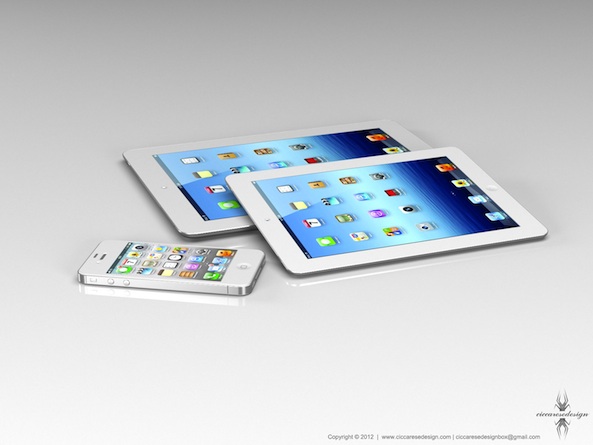
As you’ve probably gathered already by the months of chatter, Apple is widely expected to unveil a new tablet next month. It’s said to have a 7.85-inch display, and a profile as thin as the iPod touch.
Of course, since there’s been no official word from Apple regarding the product, all of this is still essentially speculation — rumors if you will. And this morning, we’ve got another one to add to the pile…
DigiTimes is reporting that Apple’s new iPad mini may be the first from the company to sport displays coated with ITO (Indium Tin Oxide), an electrically conductive substance that reduces radio noise.
“Taiwan-based Efun Technology’s profits have doubled in recent years due to ITO film and are expected to continue rising on reports that the technology will be used in Apple’s reported 7.85-inch iPad, said the sources.”
What does this mean to us as users? Well, with the reduction of radio frequency interference, we could see better connectivity from data and cellular services. And that, in turn, could equal better battery life.
It’s worth noting, however, that DigiTimes has a hit and miss record when it comes to Apple intel. As we’ve said before, it seems to use the “let’s throw everything at the wall and see what sticks” approach to journalism.
That being said, this actually sounds like something from Apple’s playbook. A new, likely low-cost tech that could help shave power usage or enhance the user experience. The rumored in-cell panels come to mind.
Anyway the media event, in which Apple is said to be unveiling this tablet alongside a new iPhone and other products, appears to be set for September 12. So hopefully we’ll get a lot of these questions answered then.


Tuesday, August 14, 2012

Burglar steals $60,000 worth of computers and personal items from Steve Jobs’ home

Late Apple co-founder Steve Jobs’ Palo Alto home was burglarized last month, according to a newspaper report today. The police included the crime in its weekend report log released to the media. A suspect was apprehended with $60,000 worth of stolen items, including computers and personal items.
Steve’s widow Laurene Powell Jobs and her children were probably not in the house when the crime took place as the Palo Alto house was surrounded with scaffolding last month amid major renovations.
A thief apparently was unaware of the famous home owners. The police wouldn’t release more details because charges had already been filed…
Jason Green, writing for The San Jose Mercury News:
The deceased Apple co-founder’s home on Waverley Street in Palo Alto was burglarized July 17, said Santa Clara County Deputy District Attorney Tom Flattery, a member of the high-technology crimes unit.
This was allegedly a random crime rather than a targeted burglary:
More than $60,000 worth of “computers and personal items” were allegedly stolen, but Flattery declined to say whether they belonged to Jobs, who died last year at the age of 56, or another family member.
Steve Jobs died in his Palo Alto home on October 5 of last year of respiratory arrest attributed to his years-long battle with cancer.
The suspect in custody has been identified as 35-year-old Kariem McFarlin. He was arraigned five days later on one count of residential burglary and selling stolen property.
He remains in county jail on $500,000 bail and could face a maximum prison sentence of seven years and eight months, including a one-year enhancement for “excessive taking of property”, according to District Attorney Tom Flattery.
Though the crime seem to be a random one, it’s interesting that the bulk of the stolen items is electronics and computers.
It’s entirely possible that McFarlin broke into the Jobs family’s home totally oblivious to who its residents were and just picked up whatever items he deemed valuable.
Contrary to his charismatic, mercurial public persona, Jobs lived a quiet and private life in his Palo Alto home. He wasn’t known for relying on security guards and cameras to protect his and his family’s privacy, like rich people mostly do.
What do you guys make of this?
Was this a random crime?


Apple shipped nearly 7 out of every 10 tablets in Q2

Joining Strategy Analytics and IDC, research firm IHS iSuppli today published findings of its second-quarter tablet research. No surprises here, Apple’s iPad remain the tablet to beat as Apple grew its tablet market share from 58.0 percent in the year-ago quarter to 69.9 percent in the second quarter of this year.
It’s the highest number since the first quarter of last year, when Apple had a 70 percent share. Making Apple’s surge even more noteworthy is the fact that a year ago Apple had fewer competitors in the marketplace…
According to IHS iSuppli data, Apple shipped nearly seven out of every ten tablets during the second quarter, enough to up its share to nearly 70 percent. The figure is up a stunning 44.1 percent from 11.8 million the first quarter, IHS iSuppli noted.
Apple is making all the right moves to rebuild its dominant position in the tablet space. The company is pushing visual performance boundaries with the new iPad, while providing value customers with a lower-priced alternative, the iPad 2.
Second-ranked Samsung shipped 2.3 million tablets, enough to grab a 9.2 percent share, down from 10.8 percent sequentially.
Amazon shipped a million Kindle Fire tablets for the #3 slot with a 4.2 percent share.
Asus, the maker of Google’s Nexus 7 tablet and its own Transformer line, shipped 688,000 units, grabbing just 2.8 percent share.
Barnes & Noble rounded up the top five with a 1.9 percent share on sales of 459,000 tablets.
Apple will be tough to beat due to its ecosystem, says the research firm:
A major component of Apple’s success to date is the company’s well-developed ecosystem of content and applications it had in place before entering the tablet market, and its absolute control of the hardware, software and operating system.
The tablet race is no longer about the hardware, it’s about the ecosystem.
When a customer buys a media tablet, what he or she is really doing is purchasing a key to that ecosystem, not just a piece of hardware.
Here’s your table.

As for Google’s Nexus 7 and Microsoft’s upcoming Surface tablet, “it’s possible that each of these vendors is entering the market intending to lead by example, rather than trying to be serious branded tablet competitors”, IHS iSuppli opines.
Another research by Analysys International pegged Apple’s China tablet share during the second quarter of this year at a whopping 72.6 percent share.
It was revealed during the Apple v. Samsung trial that nearly half of the surveyed respondents may mistaken Samsung’s Galaxy tablets for the iPad, per Apple witness Kent Van Liere.
Do you see other vendors giving the iPad a good run for its money in the near-term?