Saturday, August 18, 2012

Final day of testimonies complete in Apple vs Samsung trial

The end of the Apple-Samsung trial is drawing near, as the final day of witness testimonies is now complete. Both sides have exhausted their allotted 25 hours of arguments, and the case will soon be turned over to the jury.
In honor of this occasion, we thought we’d take a look back at some of the week’s more interesting moments in the case, from Samsung’s denial of copying Apple’s icons, to Judge Koh’s “smoking crack” comment…
Sick of the arguing – one of the more interesting aspects of this trial has been US District Court Judge Lucy Koh. She’s had no problems telling the attorneys from both sides what’s on her mind, and this week started off with her ordering them to stop arguing and agree on final jury instructions.
We didn’t copy Apple’s icons – last week, Apple’s attorneys show the jury some half a dozen images of Samsung’s icons and how they were similar to those found in iOS. This week, Samsung called on the designer of its Galaxy icons Jeeyuen Wang to testify. Obviously she testified that she didn’t copy.
Apple lifted the iPad’s design – one of Apple’s many claims against Samsung is that it intentionally copied the design of its iPad. Whether it did or didn’t, Samsung’s best line of defense against this in court is to present prior art. And it did, or at least tried to, with this tablet from 1981.
Galaxy Tab 10.1 came first – Samsung brought its industrial designer, Jin Soo Kim, to talk about the timeline of the company’s work on its Galaxy Tab 10.1 tablet. The word is, Samsung watched Apple unveil its iPad 2, and sent its designers “back to the drawing board.” This one’s interesting.
Are you smoking crack? – this hilarious line from Judge Koh probably made 1000 headlines yesterday. The comment came after Apple’s attorneys submitted a 75-page briefing of witness instructions. Koh, being the outspoken person she is, told Apple’s litigation team to pare it down.
The testimony phase ended on a dull note today. Most of the day’s witnesses were return witnesses, and Samsung’s side was pretty quiet, as it only had 46 minutes of court time left compared to Apple’s four hours.
There will likely be some last-minute filings over the weekend, and lawyers will meet with the Judge on Monday for final instructions. The trial resumes Tuesday with closing arguments, and then it’ll be handed over to the jury.
And the verdict they deliver will be one of the biggest in corporate history. If Apple wins, Samsung could owe as much as $2.5 billion dollars in damages. And if Apple loses, that opens up its designs and patents to a lot more copying.
Stay tuned.


Motorola files its second ITC suit against Apple

Google-owned handset maker Motorola Mobility on Friday filed its second lawsuit against Apple with the U.S. International Trade Commission (ITC) that could see Apple’s Mac computers, iPhones and iPads banned from sale in the United States…
Bloomberg relays an e-mail statement by the Illinois-based Droid maker:
We would like to settle these patent matters, but Apple’s unwillingness to work out a license leaves us little choice but to defend ourselves and our engineers’ innovations.
The Wall Street Journal chimed in, writing that Motorola accused Apple in the filing of breaching seven of its patents related to location-based reminders, Siri, push email notifications and media playback on cell phones, amongst others.
Motorola today also issued press invitations for an product launch slated for August 5 (Droid Razr HD, perhaps?), conveniently a week before Apple is rumored to unveil the next iPhone and the same day Microsoft/Nokia have their own Windows Phone 8/Lumia related presser.
It’s gonna be a crowded September.
Motorola and Apple locked horns over patents in 2010, following failed licensing talks. Apple argues that the Droid maker is refusing to license standards-essential patents on fair terms while claiming that Motorola’s Android-driven devices ripped off key patented features of the iPhone.
The ITC is also reviewing a previous ruling from Motorola’s first ITC case against Apple. That ruling, due August 24, could have devastating consequences for California-based Apple because asserted patents cover crucial 3G technology used in both iPhones and iPads.
Apple on its part argued that the tech is standards-essential and should be licensed at a fair and reasonable price under the FRAND act.
Remember, Motorola previously won a case against Apple in Germany over its data synchronization patent. As a result, iCloud users cannot have iCloud email pushed to their iOS devices while located within the borders of Germany.
Now that Google has completed its $12.5 billion acquisition of Motorola, effectively becoming a handset maker, any settlement gets more complicated.
While Motorola as a standalone entity may be interested to take care of its own needs, Google clearly has broader agenda, especially in light of the ongoing Apple v. Samsung litigation, currently unfolding in its third week in a San Jose court in northern California.
What do you guys make of this?


Friday, August 17, 2012

Pod2g uncovers major SMS security flaw in iOS

Despite the fact that Apple continues to receive praise for the security in iOS, hackers continue to discover vulnerabilities. Just look at all of the exploits that have been used in past jailbreaks.
Today, Pod2g adds another one to that list with his newly discovered SMS flaw. It has to do with the way the iPhone handles SMS, and could open the doors for text message spoofing…
From pod2g’s blog post:
“A SMS text is basically a few bytes of data exchanged between two mobile phones,  with the carrier transporting the information. When the user writes a message, it’s converted to PDU (Protocol Description Unit) by the mobile and passed to the baseband for delivery…
…In the text payload, a section called UDH (User Data Header) is optional but defines a lot of advanced features not all mobiles are compatible with. One of these options enables the user to change the reply address of the text. If the destination mobile is compatible with it, and if the receiver tries to answer the text, he will not respond to the original number, but to the specified one.”
He goes on to say that in a safe implementation of this feature, the recipient of a text would see the original phone number and the reply-to one. But on the iPhone, only the reply-to number appears.
As you can imagine, this could cause all kinds of problems. There are a lot of services that use text messages to verify accounts and account info, and then there’s the whole personal aspect.
The security expert says that the flaw first appeared in the original iPhone, and still exists in iOS 6 beta 4. He’s pleading with Apple to correct the problem before the final release.
And they have good reason to. Pod2g also notes in the post that he’s working on a utility that enables you to recreate this problem, without all of the hacking, and plans to release it soon.


Rumor: Apple to use special ITO film coating on iPad mini

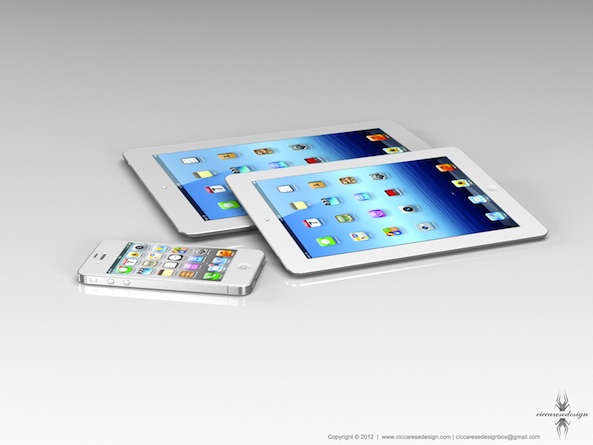
As you’ve probably gathered already by the months of chatter, Apple is widely expected to unveil a new tablet next month. It’s said to have a 7.85-inch display, and a profile as thin as the iPod touch.
Of course, since there’s been no official word from Apple regarding the product, all of this is still essentially speculation — rumors if you will. And this morning, we’ve got another one to add to the pile…
DigiTimes is reporting that Apple’s new iPad mini may be the first from the company to sport displays coated with ITO (Indium Tin Oxide), an electrically conductive substance that reduces radio noise.
“Taiwan-based Efun Technology’s profits have doubled in recent years due to ITO film and are expected to continue rising on reports that the technology will be used in Apple’s reported 7.85-inch iPad, said the sources.”
What does this mean to us as users? Well, with the reduction of radio frequency interference, we could see better connectivity from data and cellular services. And that, in turn, could equal better battery life.
It’s worth noting, however, that DigiTimes has a hit and miss record when it comes to Apple intel. As we’ve said before, it seems to use the “let’s throw everything at the wall and see what sticks” approach to journalism.
That being said, this actually sounds like something from Apple’s playbook. A new, likely low-cost tech that could help shave power usage or enhance the user experience. The rumored in-cell panels come to mind.
Anyway the media event, in which Apple is said to be unveiling this tablet alongside a new iPhone and other products, appears to be set for September 12. So hopefully we’ll get a lot of these questions answered then.